Synology DS925+ vs QNAP TS-464
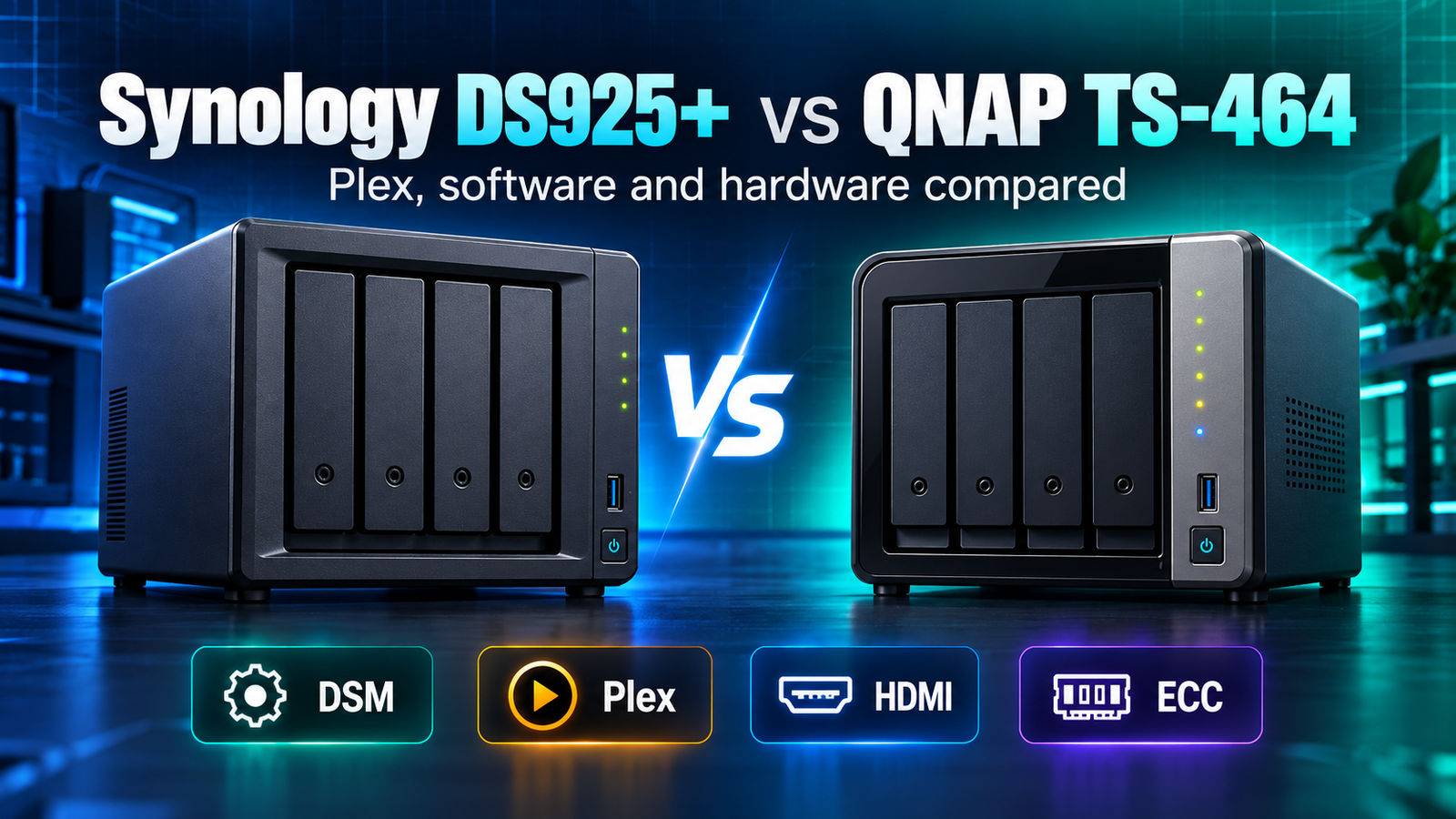
Synology DS925+ vs QNAP TS-464 comes down to Synology’s DSM-and-backup strengths versus QNAP’s more expandable Intel-based hardware. The DS925+ offers a Ryzen V1500B processor, ECC memory, dual 2.5GbE and Synology’s polished DSM ecosystem. The TS-464 uses an Intel Celeron N5095 with Intel UHD Graphics, 8GB DDR4, dual 2.5GbE, two M.2 slots, HDMI and a PCIe slot. For backup, business file services and simple administration, the DS925+ has a strong case. For Plex, hardware-assisted video, HDMI and hardware expansion, the TS-464 has advantages that Synology does not match directly.
| Feature | Synology DS925+ | QNAP TS-464 | Practical effect |
|---|---|---|---|
| CPU | AMD Ryzen V1500B, 4C/8T | Intel Celeron N5095, 4C/4T | Different strengths: Synology leans toward server workloads; QNAP includes Intel graphics. |
| Memory | 4GB ECC DDR4; up to 32GB | 8GB DDR4; up to 16GB | Synology offers ECC; QNAP ships with more RAM. |
| Networking | 2 × 2.5GbE | 2 × 2.5GbE | Similar built-in network class. |
| M.2 | 2 slots | 2 slots | Both support NVMe-related workflows. |
| Graphics / transcoding | No integrated GPU listed | Intel UHD Graphics; QNAP lists hardware-accelerated transcoding | TS-464 has the clearer media-server advantage. |
| HDMI | No | HDMI 2.1 | QNAP can connect directly to a display for supported use cases. |
| PCIe | No general PCIe expansion slot | PCIe Gen 3 x2 slot | QNAP can add network or other supported expansion cards. |
| OS | DSM | QTS; QuTS hero option supported | Software preference may outweigh raw specs. |
Affiliate disclosure: As an Amazon Associate I earn from qualifying purchases. Links to Amazon are paid links.
Check current Amazon listings: Synology DS925+ on Amazon | QNAP TS-464-8G-US on Amazon
Why these two NAS devices are compared so often
Both are four-bay desktop NAS systems aimed above entry-level storage. They can serve files, run backup jobs, host apps and containers, use NVMe storage and connect over multi-gigabit Ethernet. But they have very different personalities. Synology reduces complexity through a controlled hardware/software ecosystem. QNAP exposes more of the hardware to the owner and gives advanced users more expansion choices.
Plex and media: TS-464 has the clearer hardware advantage
QNAP explicitly lists Intel UHD Graphics and hardware-accelerated transcoding for the TS-464. QNAP also includes the TS-464 among its recommended Plex/home-cinema models and notes that Plex hardware transcoding requires the appropriate Plex capability, including Plex Pass for hardware acceleration.
The DS925+ can run media-server workloads, but its Ryzen V1500B platform does not include an integrated GPU in Synology’s listed hardware specification. If your household mostly direct-plays media, that may not matter. If you routinely transcode for remote playback or incompatible client devices, the difference becomes much more important.
Backup and administration: DS925+ is easier to justify
Synology’s advantage is the integrated DSM environment. The DS925+ is designed around Synology’s backup, file-sync, snapshots, user management and surveillance packages. For a small office, the benefit is not merely that those applications exist; it is that they share one administration model and receive updates as part of the same ecosystem.
QNAP’s QTS is also mature and feature-rich, with snapshots, storage management, apps, virtualization options and container support. It generally exposes more configuration choices, which advanced users may appreciate but newcomers may find more complex.
Memory and reliability choices
The DS925+ includes 4GB of ECC DDR4 and supports up to 32GB. The TS-464’s current 8GB configuration supports up to 16GB. ECC is not a substitute for backups, RAID or snapshots, but it is a meaningful feature for buyers who prioritize storage-system integrity and business use.
Networking is close until you add expansion
Both devices provide dual 2.5GbE ports. The QNAP then adds a PCIe expansion slot, which QNAP documents for faster networking options such as 10GbE cards. Synology’s DS925+ does not offer the same general PCIe expansion path.
If you know you need built-in 10GbE today rather than an expansion card later, also compare the UGREEN DXP4800 Plus vs Synology DS925+.
Storage expansion
The DS925+ supports Synology’s DX525 expansion unit and can scale to nine bays. QNAP offers external expansion options across its ecosystem, and the TS-464 also supports PCIe-based expansion scenarios. The right path depends on whether you prefer a tightly supported vendor expansion model or broader hardware flexibility.
Drive compatibility
Both vendors publish drive compatibility information. Synology specifically states that full functionality, reliability and performance are guaranteed for compatible drives and that support may be limited for issues caused by non-listed drives or firmware. QNAP also directs buyers to its compatibility list. Check the exact drive model, not just the brand or capacity.
Who should choose Synology DS925+?
- Small offices and professionals who want DSM’s integrated backup and administration.
- Users who value ECC memory.
- Existing Synology owners who want a familiar management environment.
- Buyers who want an official expansion path to nine bays.
Review the planned DiskBarn Synology DS925+ device page for normalized specifications and related models.
Who should choose QNAP TS-464?
- Plex users who expect to need hardware-assisted transcoding.
- Home-lab users who value HDMI, PCIe and Intel graphics.
- Buyers who want 8GB of memory out of the box.
- Users who are comfortable with a more configurable NAS platform.
Review the planned DiskBarn QNAP TS-464 device page for normalized specifications and related models.
Bottom line
The DS925+ is easier to recommend for a storage-first buyer who values DSM, ECC memory and Synology’s integrated software. The TS-464 is easier to recommend for a media-first or expansion-focused buyer who can use Intel graphics, HDMI and PCIe. Neither advantage is theoretical: the right choice depends on whether your NAS is primarily an appliance for protecting data or a flexible server that also happens to store it.
Related: QNAP TS-464 vs UGREEN DXP4800 Plus and Best 4-Bay NAS for Plex, Backup and Home Storage.