QNAP TS-464 vs UGREEN DXP4800 Plus
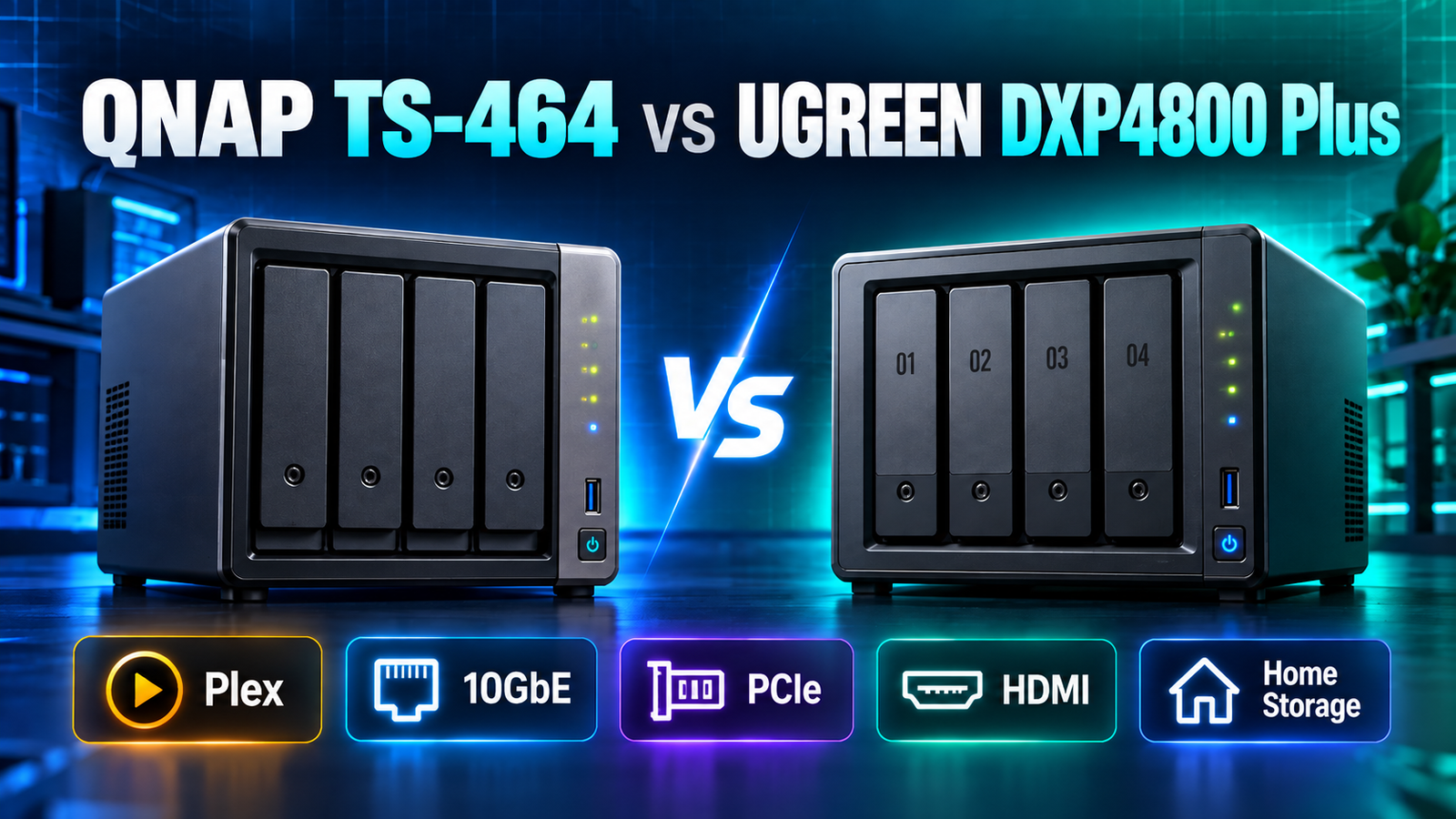
QNAP TS-464 vs UGREEN DXP4800 Plus is a particularly useful comparison for Plex, home-lab and creator workloads because both are Intel-based four-bay systems with M.2 slots, HDMI and multi-gigabit networking. The UGREEN DXP4800 Plus is the faster hardware platform on paper, with an Intel Pentium Gold 8505, 8GB DDR5 and built-in 10GbE plus 2.5GbE. The QNAP TS-464 uses the older Intel Celeron N5095, 8GB DDR4 and dual 2.5GbE, but it counters with a mature QTS ecosystem, PCIe expansion and explicit manufacturer support for hardware-accelerated transcoding.
| Feature | QNAP TS-464 | UGREEN DXP4800 Plus | What it means |
|---|---|---|---|
| CPU | Intel Celeron N5095, 4C/4T | Intel Pentium Gold 8505, 5C/6T | UGREEN has the newer, stronger CPU platform. |
| Memory | 8GB DDR4; up to 16GB | 8GB DDR5; expandable much higher | UGREEN has more memory headroom. |
| Networking | 2 × 2.5GbE | 10GbE + 2.5GbE | UGREEN wins for built-in high-speed networking. |
| GPU / transcoding | Intel UHD; QNAP lists hardware-accelerated transcoding | Intel integrated graphics; UGREEN positions the system for video transcoding | Both are media-capable, but QNAP documents the feature more explicitly. |
| M.2 | 2 × M.2 2280 | 2 × M.2 | Both support NVMe. |
| HDMI | HDMI 2.1 | 4K HDMI | Both can support display-connected workflows. |
| PCIe | Yes | No general PCIe slot | QNAP is more expandable with add-in cards. |
| OS | QTS / supported QuTS hero option | UGOS Pro | QNAP has the more mature ecosystem. |
Affiliate disclosure: As an Amazon Associate I earn from qualifying purchases. Links to Amazon are paid links.
Check current Amazon listings: QNAP TS-464-8G-US on Amazon | UGREEN DXP4800 Plus on Amazon
Plex: both are relevant, but for different reasons
QNAP lists hardware-accelerated transcoding on the TS-464 hardware specification and includes the model in its Plex/home-cinema guidance. UGREEN’s DXP4800 Plus uses a substantially newer Intel CPU platform with integrated graphics and is marketed for video-transcoding workloads.
That does not mean one box will automatically produce better Plex results for every file. Plex performance depends on whether the client direct plays, the codec and subtitle format, the bitrate, the server software and whether hardware acceleration is enabled. Plex Pass is required for Plex hardware-accelerated streaming.
10GbE changes the creator workflow
The DXP4800 Plus includes 10GbE from the factory. For a photographer or video editor working from a fast desktop with a 10GbE network, that is a major practical advantage because there is no add-in card to buy or configure. The TS-464 ships with dual 2.5GbE, and QNAP supports faster networking through PCIe expansion.
If your home network is still 1GbE, neither advantage will be fully realized. The cost of switches, adapters and cabling belongs in the buying decision.
QNAP’s PCIe slot is its hardware counterpunch
UGREEN wins on built-in networking, but QNAP gives the TS-464 a PCIe Gen 3 x2 expansion slot. That can support selected QNAP network and storage expansion cards. This is valuable if you would rather customize the NAS later than pay for every feature on day one.
Software maturity vs simpler hardware value
QTS has years of development behind it and includes snapshots, storage management, container tools, virtualization-related capabilities, multimedia applications and a broad package ecosystem. UGOS Pro is newer. UGREEN has rapidly filled in core NAS features, but a buyer with a very specific app dependency should verify that app before choosing the stronger hardware.
This distinction matters because a NAS is not a normal PC. A faster CPU cannot compensate for a missing application, backup workflow or administrative feature that your household or business depends on.
Docker and home-lab use
Both systems are reasonable home-lab candidates because they are x86-based and have enough memory for more than simple file serving. UGREEN’s CPU and memory ceiling give it attractive headroom. QNAP’s mature software and PCIe ecosystem can be more valuable to users who want a supported path for add-on networking or established QTS applications.
Storage and RAID
Both provide four SATA bays and two M.2 slots. A four-bay chassis gives more RAID and capacity flexibility than a two-bay NAS, but it also costs more once drives are included. If you are unsure whether four bays are necessary, use 2-Bay vs 4-Bay NAS before choosing either system.
Who should choose the TS-464?
- Plex users who want a manufacturer-documented transcoding-capable Intel platform.
- Users who value QTS maturity.
- Buyers who expect to use PCIe expansion.
- Home-theater users who value HDMI and QNAP’s media ecosystem.
See the planned DiskBarn QNAP TS-464 specifications page.
Who should choose the DXP4800 Plus?
- Creators and power users with 10GbE networks.
- Home-server users who want the newer CPU platform.
- Buyers who want DDR5 and high memory headroom.
- Users who value broad third-party-drive support and strong hardware per dollar.
See the planned DiskBarn UGREEN DXP4800 Plus specifications page.
Bottom line
UGREEN has the clearer raw-hardware advantage. QNAP has the clearer maturity-and-expandability advantage. If your NAS purchase is driven by 10GbE transfer speed and CPU headroom, the DXP4800 Plus is the more compelling platform to investigate. If the purchase is driven by established NAS software, Plex documentation and PCIe flexibility, the TS-464 remains highly relevant.
Related: UGREEN DXP4800 Plus vs Synology DS925+ and Best 4-Bay NAS for Plex, Backup and Home Storage.